LEGO Replay
- Timeline
- Feb – Dec 2025
- Team
- individual thesis project
- My focus
- research, service design, UX/UI, prototyping, testing
- Disciplines
- Service design, UX/UI, Circular economy, Research, Benchmarking
- Tools
- Figma, Adobe Suite
Overview
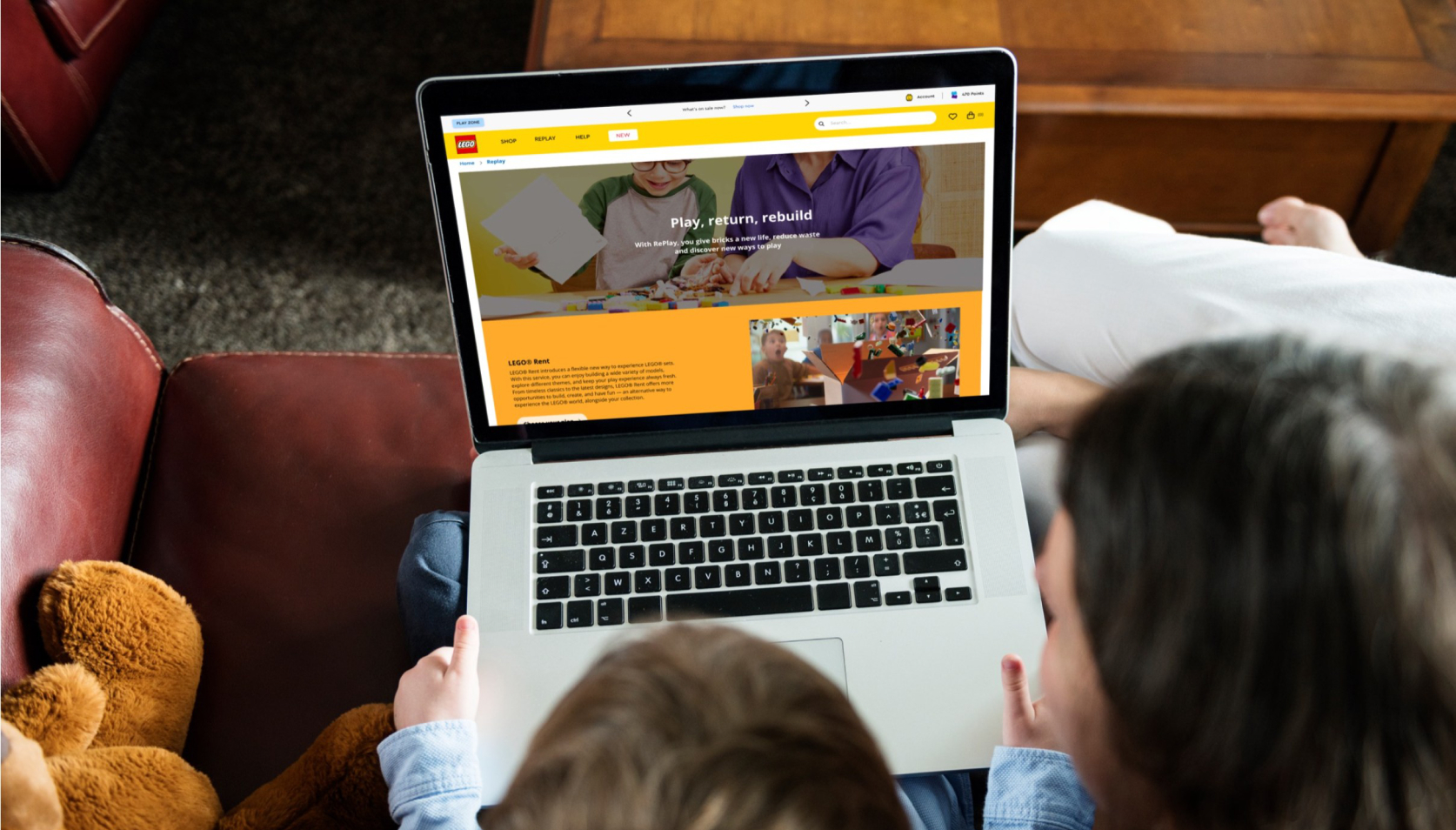
I designed a circular LEGO rental service that extends the life of bricks and makes it easy to borrow, return, and reuse sets — at home, in-store, and for operators.
Process
- Phase 1
Research
A survey with 70 people and a benchmark of 5 rental services.
- Phase 2
Personas & journeys
Giulia and Luca, mapped before, during and after a rental.
- Phase 3
Concept
Rental and trade-in in one circular system.
- Phase 4
Prototypes
Website and app flows inside LEGO’s ecosystem.
- Phase 5
Usability testing
10 participants, 3 scenarios.
Starting point
Can LEGO leave rental to third parties, when it touches sustainability, experience and digital engagement?
Independent services already let people rent LEGO sets instead of buying them, while millions of still-functional toys are thrown away every year. Bricks can be used, taken apart and rebuilt many times: a natural fit for a circular model.
Research
No one had rented LEGO before, but about half would try.
People expect one to three sets a month, home delivery and pickup, and an app with reminders. A benchmark of five rental services showed what an official one must get right: trust in quality, clear policies, reliable logistics.
- 01
Giulia, 23 — young adult
Limited budget and space; renting lets her build regularly without commitment.
- 02
Luca, 36 — millennial parent
Rotating sets keeps his son’s play fresh without cost, clutter or waste.
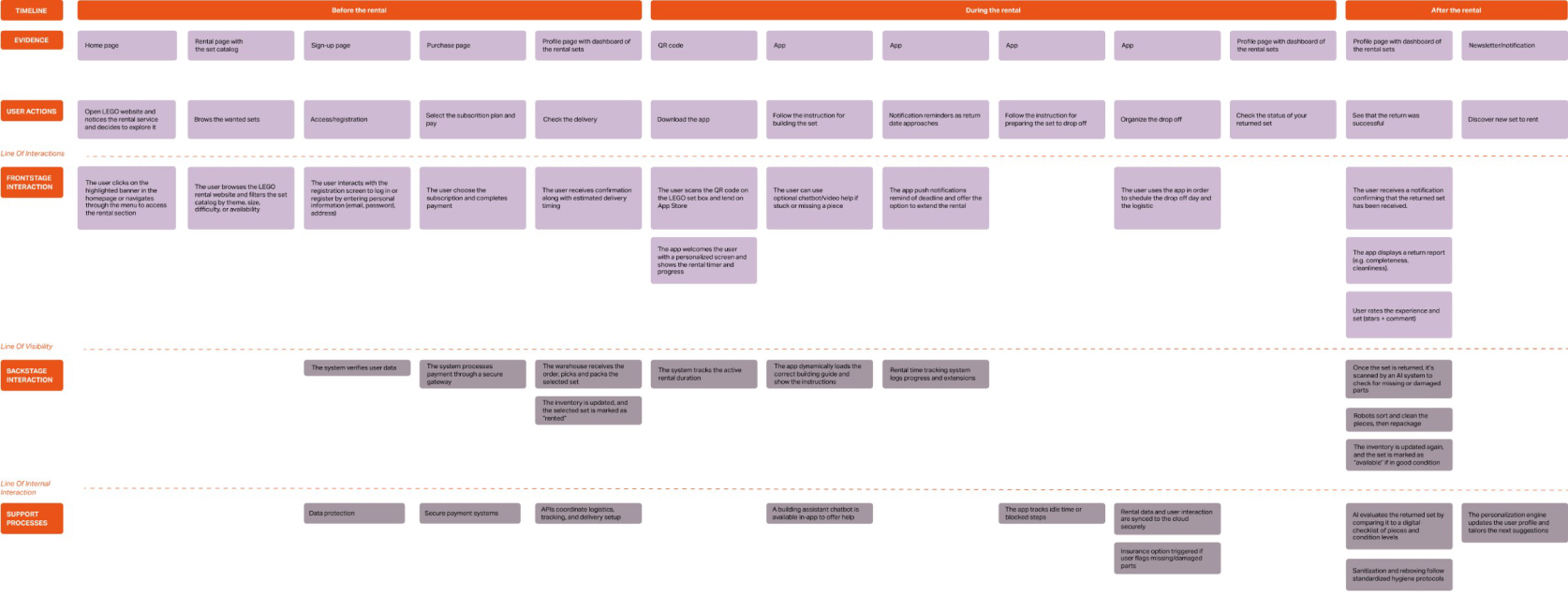
Giulia — renting a set: before, during and after the rental.
Concept
Rental and trade-in in a single circular system, inside LEGO’s existing ecosystem.
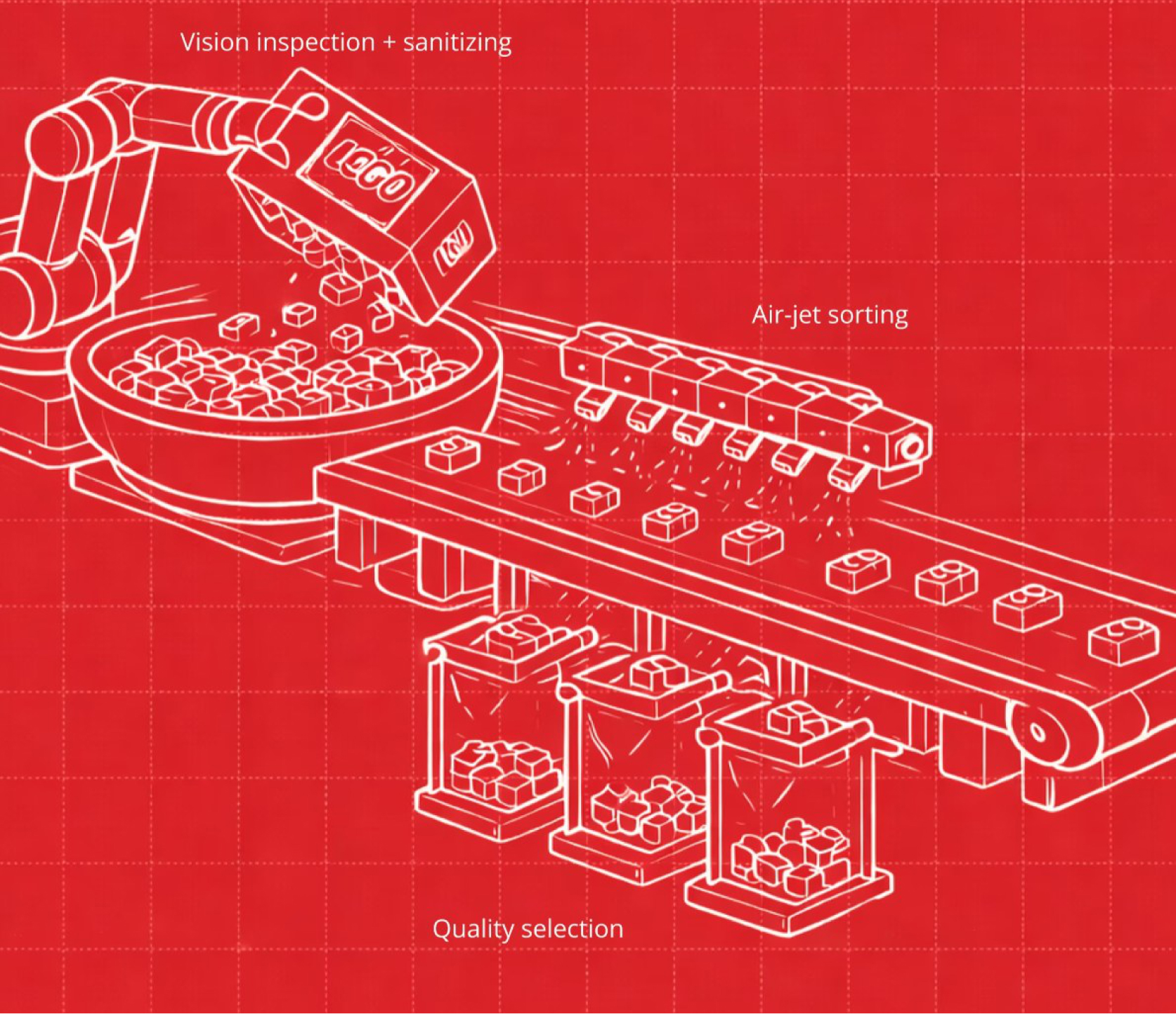
Users rent sets through the LEGO website and app, and return underused ones for points or credit. Returned sets are inspected, refurbished and put back into circulation; incomplete ones become spare parts.
- Step 1
Rent
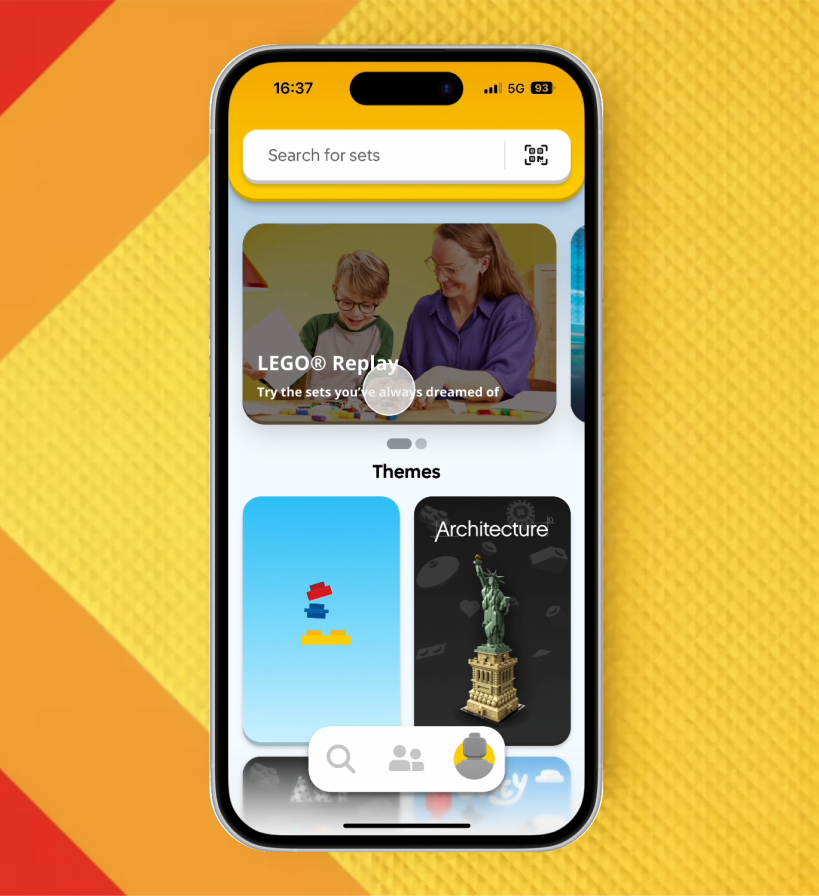
Pick a set on LEGO.com or in the app.
- Step 2
Return
Send back underused sets for points or credit.
- Step 3
Refurbish
Sets are inspected, cleaned and graded A/B/C.
- Step 4
Recirculate
Back in the catalogue; incomplete sets become spare parts.
Key design decisions
Trust comes first: people need to know what has been done to the set they receive.
- 01
Quality as a service promise
clear cleaning standards and A/B/C set grading.
- 02
Service logic before UI
the full lifecycle mapped before designing screens.
- 03
Trust mechanics over punishment
credits for timely, complete returns.
- 04
Return-ready packaging
modular containers and labels for fast sorting.
Digital integration
How can rental and trade-in be added to LEGO.com and the Builder app without fragmenting the experience?
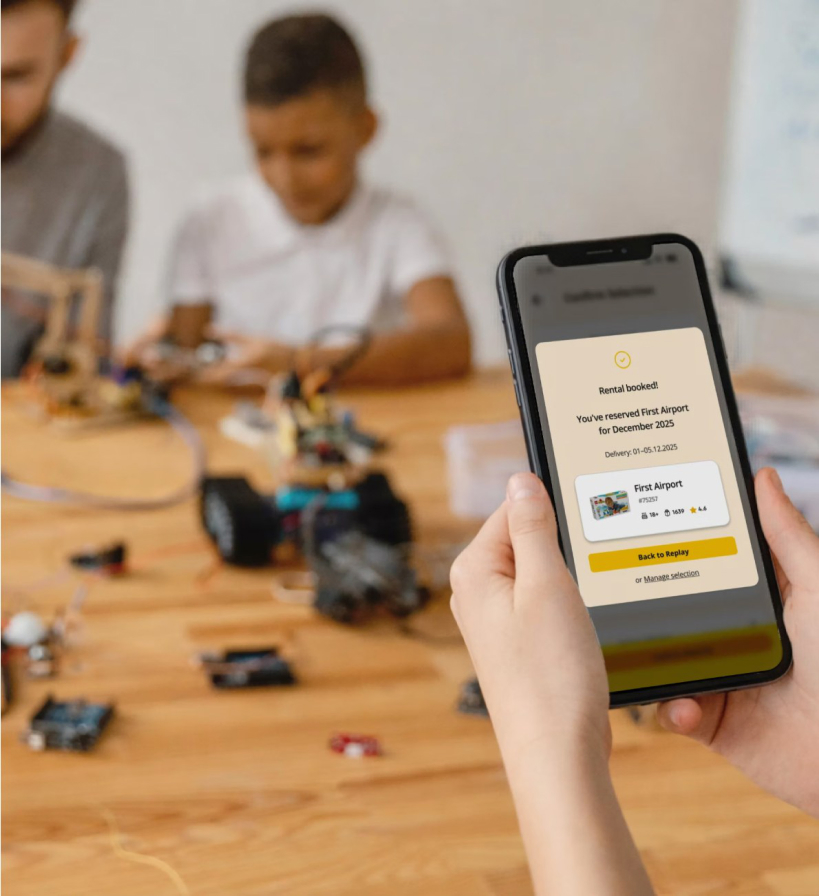
Replay reuses existing LEGO patterns — cards, filters, checkout, account pages — so rental and trade-in live inside the current system.
- 01
First rental
compare plans, pick a set, confirm in the familiar checkout.
- 02
Active rental
one card with dates, a countdown and quick actions.
- 03
Trade-in
mark the condition, choose shipping or drop-off, get a timeline for credit.
Usability testing
The circular idea works only if the journey is crystal clear.
Ten participants with mixed LEGO familiarity tried three scenarios: first rental, rental management and trade-in, in moderated sessions. The renting path was hard to find and trade-in lacked a “what happens next” step. Making entry points and confirmations more visible reduced confusion, and one shared points system made returning sets feel like unlocking the next build.
Limits and next steps
Encouraging results, from a small prototype-based study.
No real payments or live operations yet. The next step is a geo-limited pilot with a reduced catalogue, tracking turnaround, damage, packaging reuse and churn.